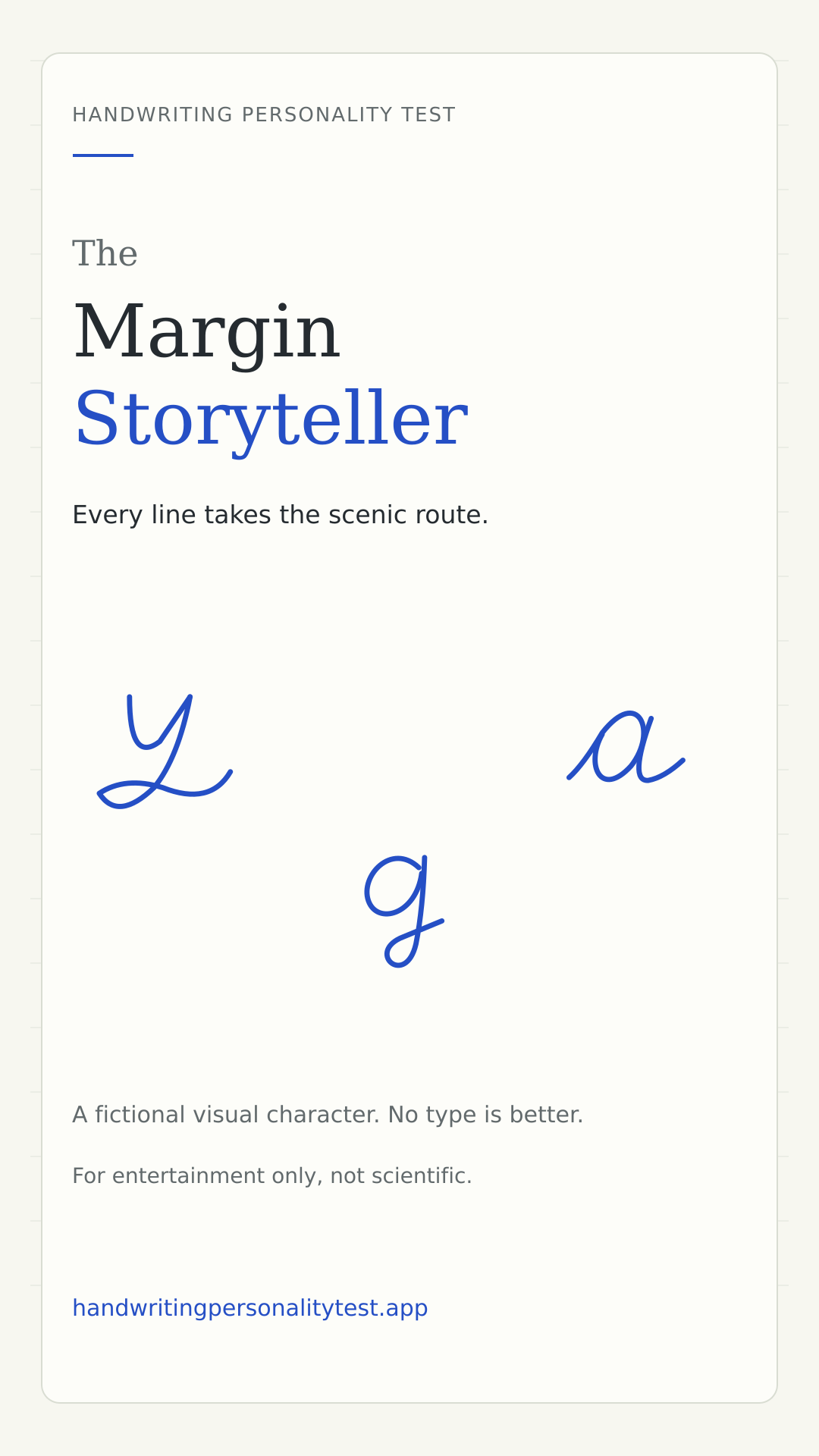
The Margin Storyteller
Every line takes the scenic route.
For entertainment only, not scientific. This is a public type guide, not a personal result.
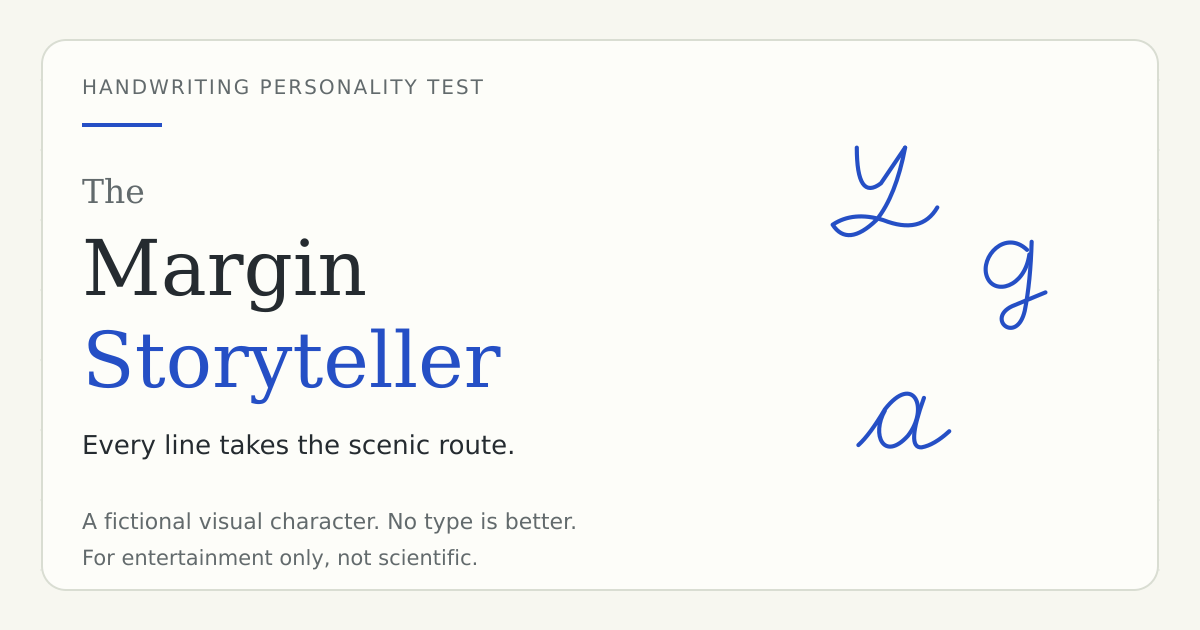
The Margin Storyteller is our fictional portrait of flowing shapes and generous finishing gestures. Picture a returning g-tail, a joined a and a y that takes a longer route below the line. The title borrows a narrative mood from those movements. It does not prove that the writer is creative, talkative or naturally good at telling stories. Structured numerals can still appear in the mix; the result reflects the overall balance of selected or measured visual cues.
The visual cues behind the character
- Curves, returns and connected-looking forms
- Noticeable finishing gestures
- A comparatively expansive visual rhythm
Why the margin is part of the metaphor
A long tail can carry a letter beyond the space occupied by its ordinary body. A connected form can make the eye travel into the next letter. Together, such choices can give a sample a sense of motion, which inspires our storytelling character. That does not mean the writer ignores boundaries or enjoys long conversations. The margin is a visual image, not an assessment of social behavior. Your private result keeps the actual selected samples beside the narrative.
Look for the returns and connections you really chose
The illustrative g, y and a on this page introduce three different ways a stroke can move. A loop returns and closes a space, a sweeping tail extends outward, and a joining stroke connects to another form. Your result may emphasize only some of those qualities. Review the answers to distinguish them rather than calling everything cursive or decorative. A clear distinction between loop, tail and connection makes the visual explanation more useful than a single broad adjective.
How a written trace can reach this type
Drawing mode can move toward a flowing and expansive prototype when available slant, local height, gap and movement cues combine in that direction. It is not reading your sentence or recognizing a dramatic y. Some of the geometry may come from the device or the available canvas space. Check the reported values and the contribution explanations before accepting the story. Pressure remains unavailable when the browser cannot verify a varying device signal, even if the line looks bold.
A short-note experiment
Write one sentence about an ordinary moment, then write the same sentence again with a little less room for the final strokes. Keep the words unchanged. Compare where the tails travel, whether loops still have visible interiors and whether the next line remains clear. You are exploring how a layout constraint changes the marks. The experiment does not ask you to become less expressive, and it does not assume that a broad loop measures an imaginative mind.
Use the story as an invitation, not a finding
The reflection prompt asks which small moment you would keep in a handwritten note. Answering can be enjoyable whether or not the character describes you outside the quiz. What would be misleading is presenting the result as proof of artistic talent, emotional openness or a particular relationship style. The story is written by the site, while your actual experiences belong to you. A playful name can start a conversation without supplying its conclusions.
How Storyteller differs from the rest of the cast
Beautiful Rebel emphasizes distinctive constructions and extra visual touches, while Margin Storyteller leans into flow and generous gestures. Daydream Doodler gives more of its fictional attention to openness and room. These patterns overlap in some choices, so a small edit can bring a nearby type closer. None is the most creative or the most interesting type. Explore the neighboring pages to see the differences in the recipe rather than to find a more flattering description.
A gentle roast, not a diagnosis
You started writing “just a quick note” and accidentally gave the letter y its own character arc. The margin would like a word.
The roast is deliberately fictional. It is written for the character rather than inferred as a fact about you. Keep the joke only as far as it is enjoyable, and do not use it to explain another person's behavior.
A question to take away
What small moment from today would you want to keep in a handwritten note?
How to get and inspect your own result
The sample-choice quiz asks twelve questions and needs at least eight selected answers. Its existing rules average visual contributions and choose the nearest preset pattern. Skipped questions do not become hidden selections. Your private result keeps the actual choices available to inspect, edit, save and compare.
The private drawing mode uses a different input and a separate transparent recipe. It estimates geometric features without recognizing the words or uploading the trace. Missing measurements contribute nothing. Both modes use these same six character names, but there is no guarantee that a chosen sample and a drawing on glass will produce the same match.
Common questions about this type
Is this a rare or better result?
No. The site makes no claims about rarity, user percentages or a hierarchy of personalities. It is a named visual pattern in an entertainment recipe.
Does this public page contain my answers?
No. This page describes the general character and can be visited by anyone. It contains no personal answers, handwriting image, coordinates, timing or pressure values.
Can handwriting validate the personality story?
No. The character is not a scientific assessment. The science guide explains the evidence boundary, and the methodology describes the original quiz rules.
Share the character, not private handwriting
These cards use the site's original illustrative glyphs. They do not show a user's drawing or selected answers. Choose the portrait card for a story-sized image or the landscape card for a link preview.