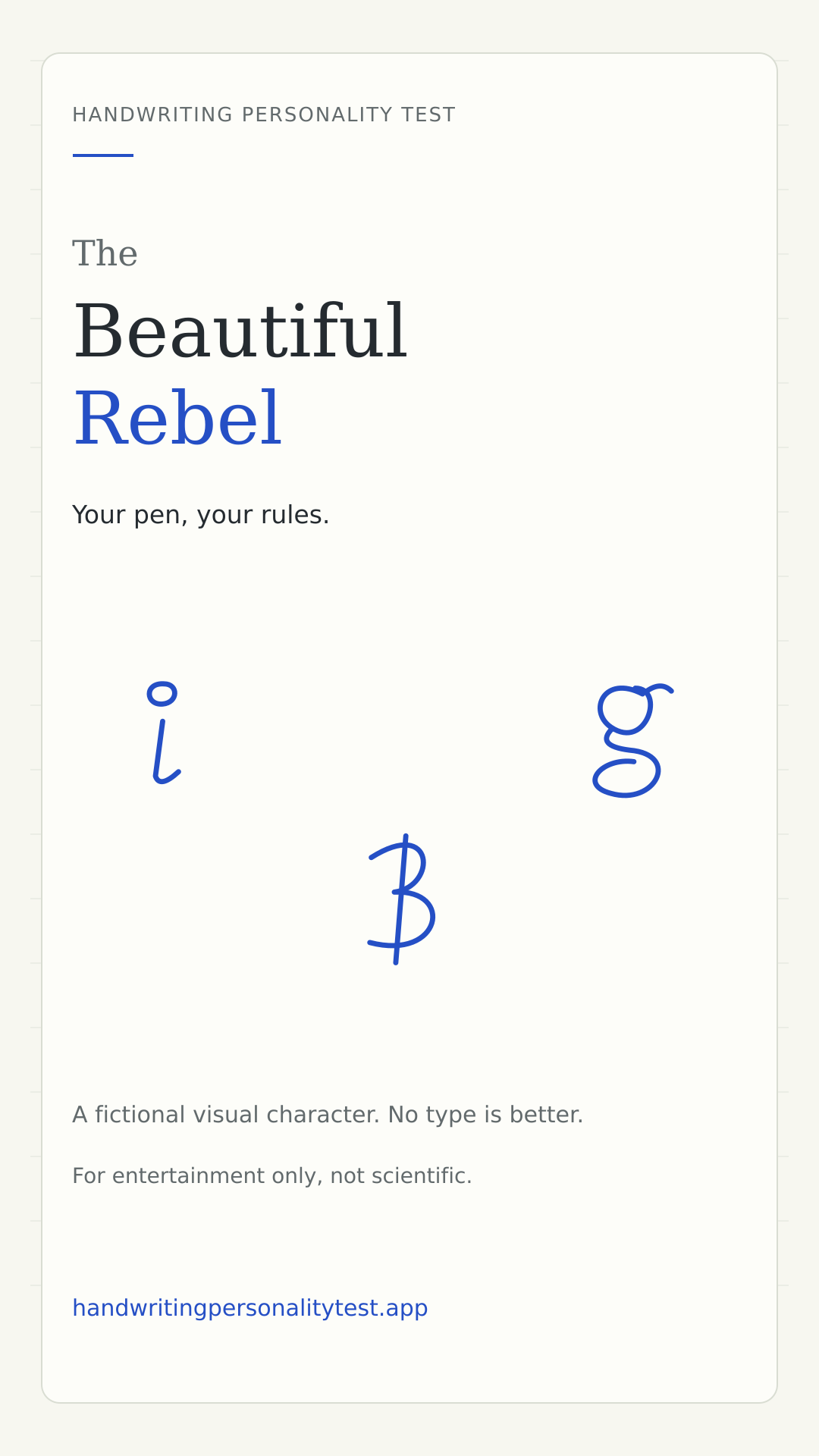
The Beautiful Rebel
Your pen, your rules.
For entertainment only, not scientific. This is a public type guide, not a personal result.
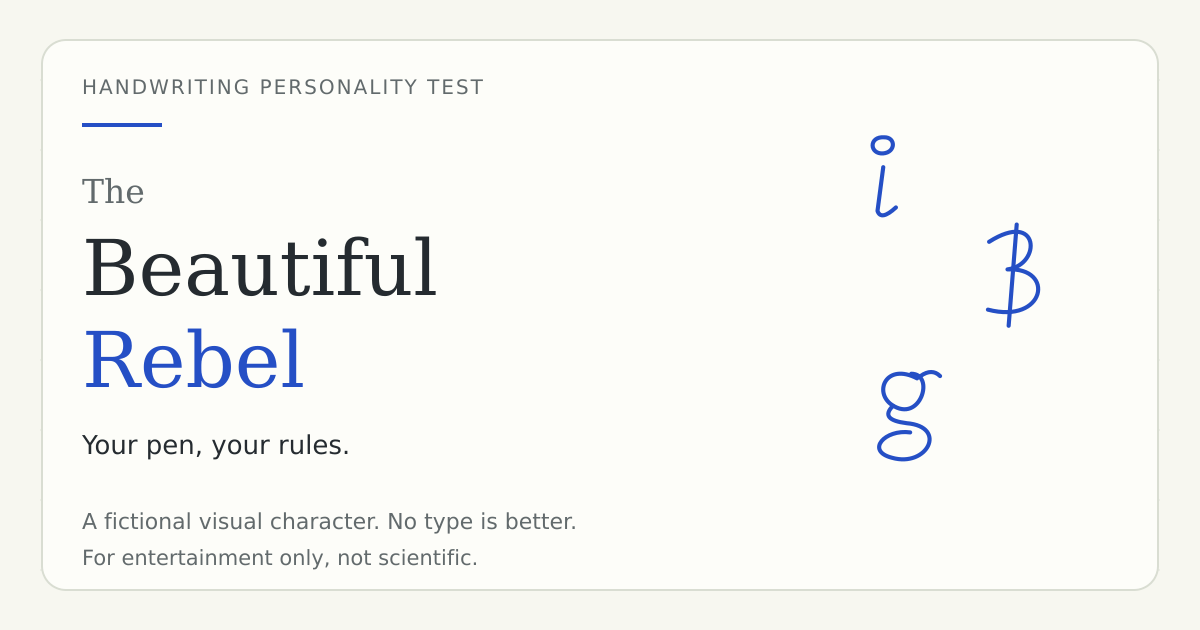
The Beautiful Rebel is our fictional character for distinctive constructions and noticeable finishing choices. An open circle over an i, a crossed-three ampersand or a double-storey g can make a set of samples feel individually styled. The name does not prove independence, rebellious behavior or creative ability. “Individual” is an editorial design-axis label, not a comparison with population data. The interesting part is the combination you actually supplied, not a claim that your writing is rare.
The visual cues behind the character
- Alternate familiar constructions
- Extra finishing marks or enclosed details
- Visible contrast within the sample set
A familiar letter can take a different route
Two forms can represent the same letter or symbol while using different constructions. A circle over an i adds an enclosed shape; an ampersand can follow a shortcut that looks like a crossed three. Those differences are real enough to compare without saying that they reveal a rule-breaking personality. The character celebrates visual alternatives within the site's sample set. It does not claim to have found a rare handwriting trait or a distinctive biometric identity.
The examples are not a required costume
You do not need all three illustrated glyphs to receive this result. The original quiz combines many contributions, and a similar overall pattern can arise from another set of choices. A simple seven can coexist with an elaborate g. Review your private answer breakdown for the details that actually belong to your result. Treat the illustrations here as an introduction to the fictional character rather than instructions for how a Beautiful Rebel must write.
What individual means in drawing mode
The drawing recipe includes a visual-contrast cue based on variation in local ink height. That measure is an approximation of the trace's silhouette, not evidence that the writer is more original than other people. The site has no population ranking behind it. Other available geometric cues affect the nearest type as well. A varying pressure signal can add editorial emphasis, but an unsupported device never earns a fabricated heavy-pressure interpretation.
Change one small finish and compare the whole word
Write a short word containing i several times, using your ordinary letters. On one version, replace the usual point with a small open circle. On another, make the mark a short dash. Compare the result at normal reading size rather than only in a close-up. A visible difference can be a deliberate style choice. It does not follow that changing the mark changes your creativity, maturity or character, and there is no need to adopt it permanently.
Keep the reflection separate from the evidence
The character invites you to name a small everyday choice that feels your own. That choice might be how you label a notebook or arrange a heading. Your explanation comes from your preferences, not from a hidden property of the ampersand. Avoid reading another person's decorative mark as vanity, defiance or an attempt to attract attention. Those are claims about motives that a shape alone cannot establish.
No rare-type claim is hiding behind the name
Beautiful Rebel is one of six accessible editorial patterns, not a premium result or a statistically unusual category. The site does not claim that only a certain fraction of users receive it. Margin Storyteller puts more emphasis on flow, while Instinctive Mixer describes a more central blend. Looking at those differences can help explain the design recipe, but it should not become a contest over which person has the most interesting personality.
A gentle roast, not a diagnosis
At some point you saw a perfectly normal letter and said, “I can make this a little more complicated.” Honestly, your i-dot has a personal brand.
The roast is deliberately fictional. It is written for the character rather than inferred as a fact about you. Keep the joke only as far as it is enjoyable, and do not use it to explain another person's behavior.
A question to take away
Which small choice in your everyday life feels unmistakably your own?
How to get and inspect your own result
The sample-choice quiz asks twelve questions and needs at least eight selected answers. Its existing rules average visual contributions and choose the nearest preset pattern. Skipped questions do not become hidden selections. Your private result keeps the actual choices available to inspect, edit, save and compare.
The private drawing mode uses a different input and a separate transparent recipe. It estimates geometric features without recognizing the words or uploading the trace. Missing measurements contribute nothing. Both modes use these same six character names, but there is no guarantee that a chosen sample and a drawing on glass will produce the same match.
Common questions about this type
Is this a rare or better result?
No. The site makes no claims about rarity, user percentages or a hierarchy of personalities. It is a named visual pattern in an entertainment recipe.
Does this public page contain my answers?
No. This page describes the general character and can be visited by anyone. It contains no personal answers, handwriting image, coordinates, timing or pressure values.
Can handwriting validate the personality story?
No. The character is not a scientific assessment. The science guide explains the evidence boundary, and the methodology describes the original quiz rules.
Share the character, not private handwriting
These cards use the site's original illustrative glyphs. They do not show a user's drawing or selected answers. Choose the portrait card for a story-sized image or the landscape card for a link preview.