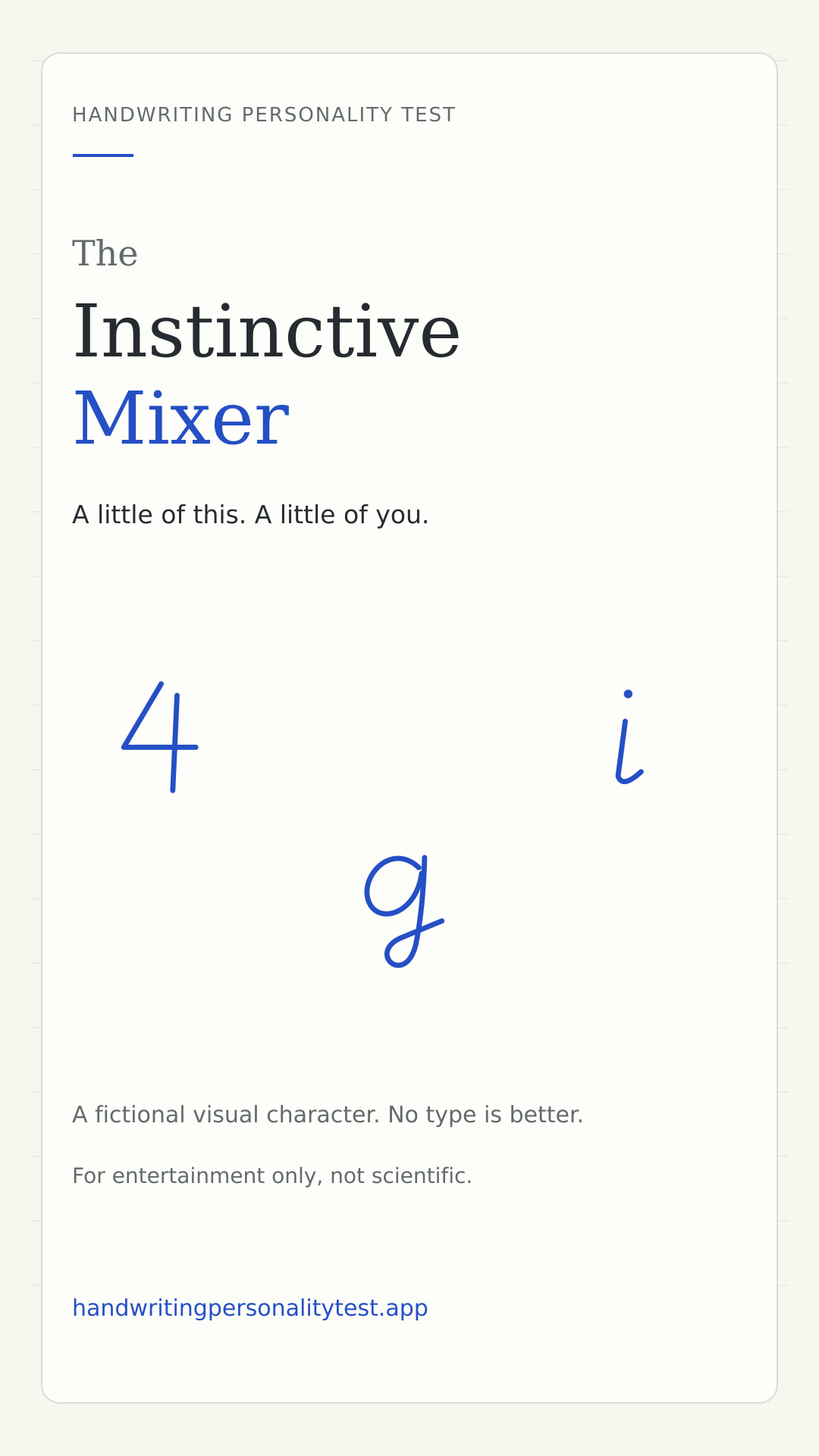
The Instinctive Mixer
A little of this. A little of you.
For entertainment only, not scientific. This is a public type guide, not a personal result.
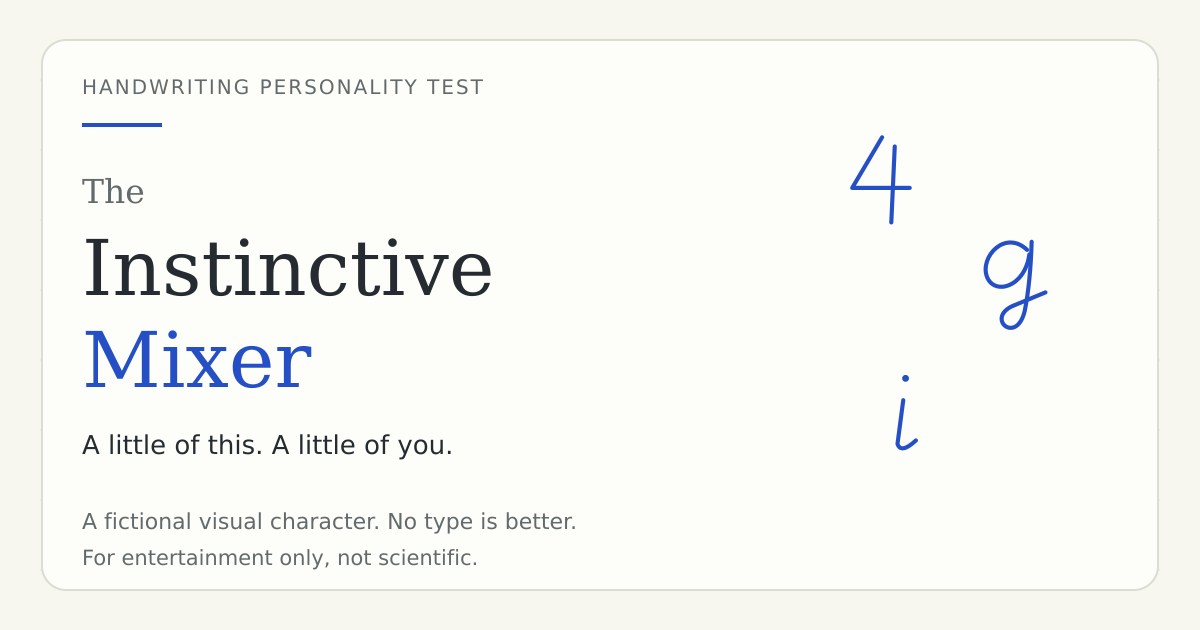
The Instinctive Mixer is our fictional character for a combination that stays near the middle of the site's visual patterns. A simple numeral might sit beside a looped letter, with a small finishing point elsewhere. The name does not mean that the test failed or that the writer has an inconsistent personality. It describes how different visible approaches balance within this particular editorial recipe. Mixed handwriting can be perfectly ordinary and does not need to be forced into a more dramatic category.
The visual cues behind the character
- A blend of simple and detailed choices
- No single visual direction strongly dominating
- Different familiar constructions sharing a sample
The middle is a real part of the recipe
The Mixer prototype sits at the center of the four visual axes. Selected cues that pull in different directions can leave the combined result close to that center. This is not a hidden error state or a reward for being average. The site does not compare the result with a population distribution. It is simply one of the six fictional patterns used to turn a combination of marks into a readable character story.
Look for the contrasts in the actual answers
A plain one can contribute visual economy while a looped g contributes a returning curve. An open four can add space while another choice anchors the layout. Review those details separately instead of describing everything as inconsistent. The private result breakdown keeps each chosen sample visible, so the interesting question is which approaches share the page. The illustrative glyphs here are only examples, not an exhaustive list of combinations that produce the Mixer.
What a mixed drawing result does not hide
Drawing mode can also produce a central balance when available geometric cues offset one another. Missing measurements contribute zero rather than invented observations, and the result lists what was unavailable. That means you should read the quality notes as well as the name. The tool still does not recognize words, identify letters or certify a psychological mixture. It is a transparent comparison between approximate coordinates and a small set of editorial prototypes.
Change one answer and watch the explanation
From a private quiz result, choose one answer to edit and leave the others unchanged. Try replacing a simple tail with a loop or an undecorated numeral with a more detailed version. Inspect the notes after the update. The result may remain Mixer or move to a nearby type. Either outcome can teach you how the recipe combines cues without pretending that one altered letter changed the way you think or behave.
A reflection about combinations you actually enjoy
The prompt asks which two different sides of your style work well together. You might like a clear heading above a playful note, or a simple list with one decorative symbol. Your answer comes from your experience and preferences. The test does not prove adaptability, indecision or complexity. A mixed visual sample deserves an accurate description, not a psychological explanation invented to make the result sound more profound.
There is no need to chase a stronger label
The other five types emphasize different parts of the visual space, but they are not more complete or more valuable results. Retaking the test until you get a more flattering title misses the useful comparison of actual shapes. You can explore every public type page without earning access to it. Keep the Mixer as a light description of this sample's combination, and let the next ordinary note remain free to look different.
A gentle roast, not a diagnosis
You use three different versions of the same letter depending on the pen, the weather, and whether anyone is watching. Consistency has left the group chat.
The roast is deliberately fictional. It is written for the character rather than inferred as a fact about you. Keep the joke only as far as it is enjoyable, and do not use it to explain another person's behavior.
A question to take away
Which two different sides of your style work surprisingly well together?
How to get and inspect your own result
The sample-choice quiz asks twelve questions and needs at least eight selected answers. Its existing rules average visual contributions and choose the nearest preset pattern. Skipped questions do not become hidden selections. Your private result keeps the actual choices available to inspect, edit, save and compare.
The private drawing mode uses a different input and a separate transparent recipe. It estimates geometric features without recognizing the words or uploading the trace. Missing measurements contribute nothing. Both modes use these same six character names, but there is no guarantee that a chosen sample and a drawing on glass will produce the same match.
Common questions about this type
Is this a rare or better result?
No. The site makes no claims about rarity, user percentages or a hierarchy of personalities. It is a named visual pattern in an entertainment recipe.
Does this public page contain my answers?
No. This page describes the general character and can be visited by anyone. It contains no personal answers, handwriting image, coordinates, timing or pressure values.
Can handwriting validate the personality story?
No. The character is not a scientific assessment. The science guide explains the evidence boundary, and the methodology describes the original quiz rules.
Share the character, not private handwriting
These cards use the site's original illustrative glyphs. They do not show a user's drawing or selected answers. Choose the portrait card for a story-sized image or the landscape card for a link preview.